
.webp)


Most virtual try-on tools are built around one impressive moment: generating the image.
A shopper uploads a photo.
The AI creates a try-on result.
The product appears on the shopper.
For a demo, that may be enough.
For a fashion store, it is not.
Because a clothing sale does not happen when someone looks at a generated image. It happens when that shopper decides what to do next.
Do they keep browsing?
Do they compare another color?
Do they leave?
Do they save the product for later?
Do they add it to cart?
That is the part many AI virtual try-on tools do not think deeply enough about.
ETRYON was built around a different question:
What happens after the try-on?
The Try-On Result Is Not the Finish Line
Virtual try-on is often presented as a visual feature.
That makes sense at first. Fashion is visual. Fit, style, color, shape, and personal imagination all matter.
But if the try-on experience ends with a generated image, it stops too early.
A shopper may like the result and still fail to act.
Not because the image was bad.
Not because the product was wrong.
But because the next step was unclear.
This is a small design problem with a large commercial consequence.
The try-on result is the moment when the shopper has the most context. She has already shown interest in the product. She has taken the time to upload or capture a photo. She has waited for the result. She is no longer casually scrolling.
That moment should not become a dead end.
The Real Question Is Behavioral
A better way to evaluate virtual try-on is not:
Can this tool generate a realistic image?
That question matters, but it is incomplete.
The better question is:
What behavior does the try-on result create?
For a fashion ecommerce store, there are only a few outcomes that matter after a shopper sees the result:
- She continues browsing.
- She checks another product or variant.
- She leaves the store.
- She saves or shares the result.
- She joins an email list.
- She applies an offer.
- She adds the product to cart.
This is where virtual try-on becomes more than an AI feature.
It becomes part of the product-page decision system.
Why Image-Only Try-On Feels Impressive but Often Underperforms
Image-only try-on tools can look strong in screenshots.
They are easy to show.
They are easy to understand.
They make good demos.
But ecommerce is not a demo environment.
A real product page has variants, prices, shipping concerns, return questions, size uncertainty, cart behavior, and brand styling. The shopper is not simply asking, “Can AI put this dress on me?”
She is asking something more practical:
Do I want this one enough to take the next step?
If the try-on result appears in a disconnected modal, the shopper may have to close it, return to the page, re-check the product, choose options again, and then find the cart button.
That is too much work for a moment that should feel natural.
The result may be visually interesting, but commercially weak.
ETRYON Connects Try-On to Add-to-Cart
ETRYON takes a different approach.
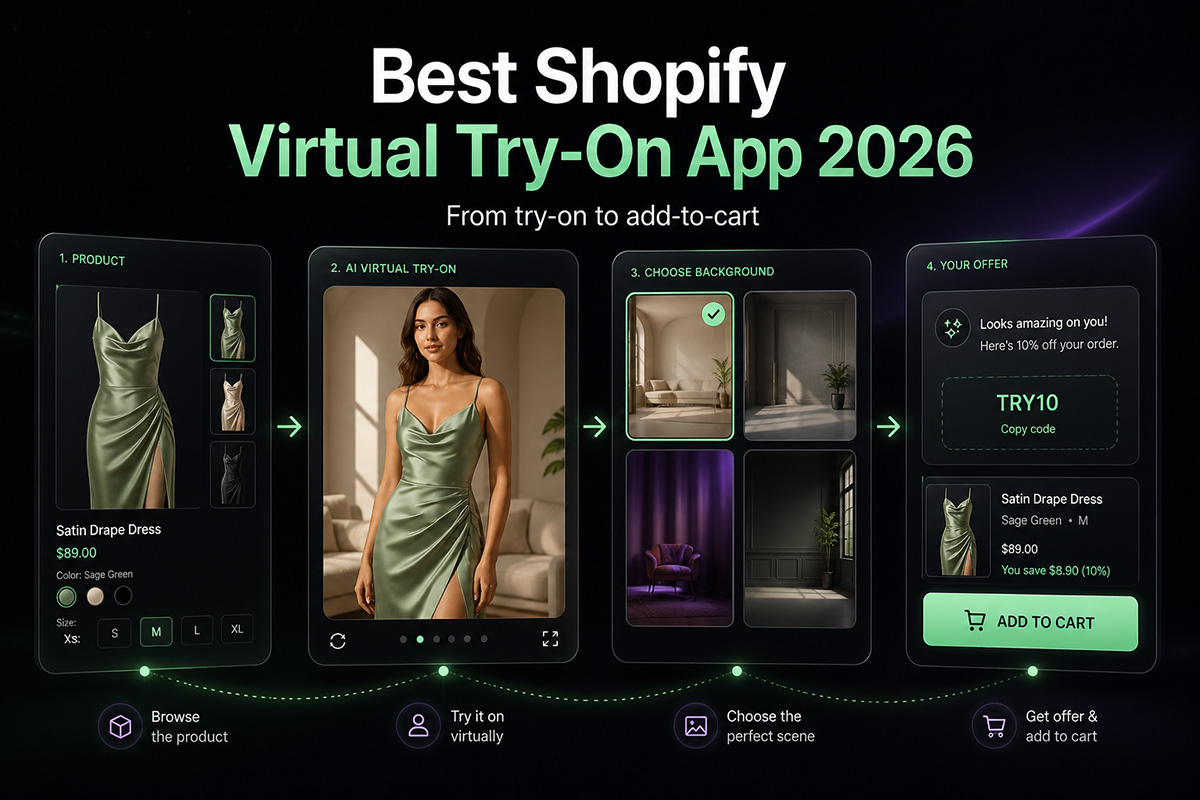
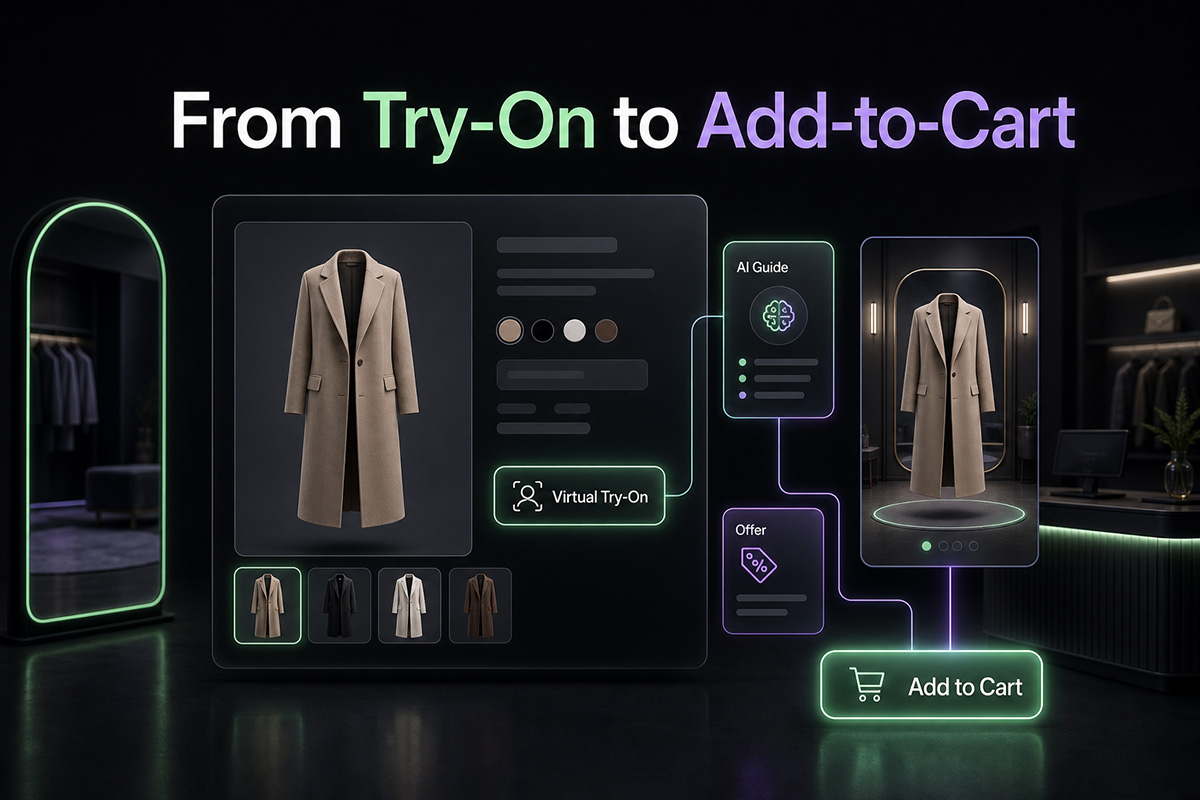
Instead of treating AI virtual try-on as a standalone image generator, ETRYON connects the try-on result with the product-page buying flow.
That means the experience is designed around what shoppers do after the preview appears.
On supported Shopify and WooCommerce fashion stores, ETRYON helps merchants bring the try-on action closer to the product decision. The shopper can preview the item, stay connected to the product context, and move toward add-to-cart without feeling like the try-on was a separate experience.
This distinction matters.
A virtual try-on tool that only answers “How does this look?” is useful.
A virtual try-on system that also asks “What should happen next?” is much more aligned with how fashion ecommerce actually works.
You can see the product experience here: ETRYON live demo.
Post-Try-On Flow Changes the Role of AI
When virtual try-on is connected to add-to-cart, the role of AI changes.
It is no longer there only to impress the shopper.
It is there to support a decision.
That decision may still be no. The shopper may decide the product is not right. That is fine. A useful try-on flow does not need to force every shopper toward checkout.
But when the answer is yes, the path should be obvious.
That is where post-try-on design becomes important.
A strong post-try-on flow can include:
- Product details near the result
- Selected product or variant context
- A clear add-to-cart action
- A lightweight post-try-on offer
- A way to continue browsing without losing context
- Storefront analytics that show what shoppers did next
This is the layer that separates a visual AI widget from a fashion ecommerce tool.

The Best Try-On Moment Is Already High Intent
Not every shopper who visits a product page is ready to buy.
But a shopper who starts a try-on is different.
She has gone beyond passive browsing. She is testing the product against herself, not just against a model photo.
That makes the post-try-on moment valuable.
It is not the right time to bury the shopper in extra steps.
It is not the right time to send her away from the product.
It is not the right time to make her restart the buying process.
It is the right time to offer a clear next action.
For some stores, that action is add-to-cart.
For others, it may be choosing a variant, viewing another item, or receiving a carefully timed offer.
ETRYON is designed to support that moment instead of letting it disappear.
Merchants Also Need to Measure What Happens Next
If a store only knows how many try-on images were generated, it is missing half the picture.
Generation count tells you usage.
It does not tell you whether the try-on experience helped shoppers move forward.
A more useful view includes questions like:
- How many shoppers saw the try-on button?
- How many clicked it?
- How many completed an upload?
- How many generations succeeded?
- How many shoppers added to cart after try-on?
- Which products created the strongest post-try-on actions?
ETRYON tracks storefront try-on behavior so merchants can evaluate the full flow, not only the image output.
That matters because virtual try-on should be judged like an ecommerce experience, not only like an AI image feature.
This Is Why Product-Page Integration Matters
Virtual try-on works best when it lives where the buying decision already happens.
For Shopify, that means the product page. ETRYON can be installed through the Shopify App Store and added through the Shopify theme workflow.
For WooCommerce, ETRYON works through a WordPress plugin and connects through an API key from app.etryon.ai.
The setup is different by platform, but the principle is the same:
Try-on should not pull shoppers away from the product decision.
It should sit close to the product, the selected options, the offer, and the cart action.
You can explore ETRYON apps here: ETRYON Apps.
Virtual Try-On Should Earn Its Place on the Product Page
Fashion product pages are already crowded.
Images, descriptions, variants, size guides, reviews, shipping notes, discount messages, and checkout buttons all compete for attention.
So virtual try-on has to earn its space.
It earns that space when it does more than create a fun visual moment.
It earns that space when it helps the shopper make a clearer decision and gives the store a cleaner path from interest to action.
That is why the post-try-on flow matters.
The image is the beginning.
The next action is where the business value starts.
Final Thought
Virtual try-on is not enough on its own.
A generated image can catch attention, but attention is not the same as progress.
For fashion ecommerce stores, the real question is what happens after the try-on result appears.
ETRYON is built for that moment: connecting AI virtual try-on with product context, post-try-on offers, and add-to-cart actions so shoppers have a clear next step when their interest is already higher.


.avif)

