
.webp)

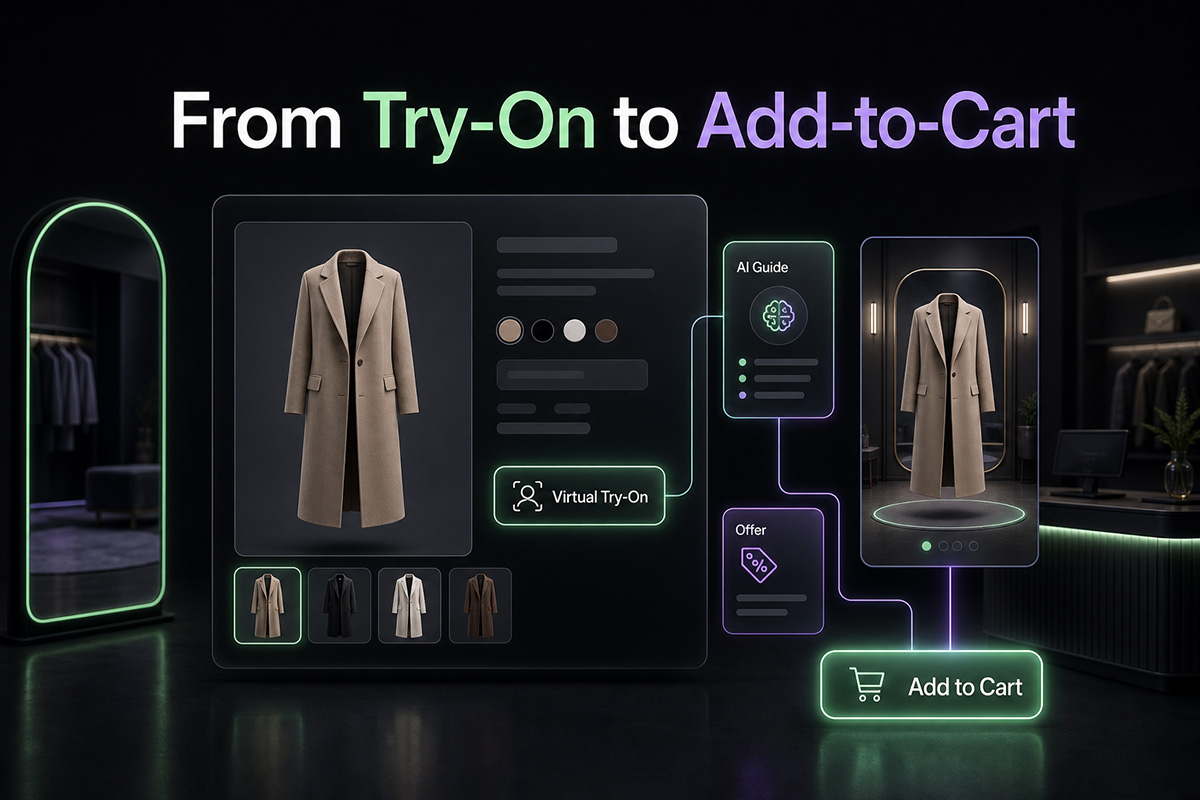
Online fashion stores have advantages that physical stores cannot match: unlimited shelf space, global reach, lower operating costs, faster testing, and 24/7 sales.
But physical stores still have something ecommerce often lacks.
- A fitting room
- A sales associate
- A timely offer
- A natural path from "I like this" to "I'll take it"
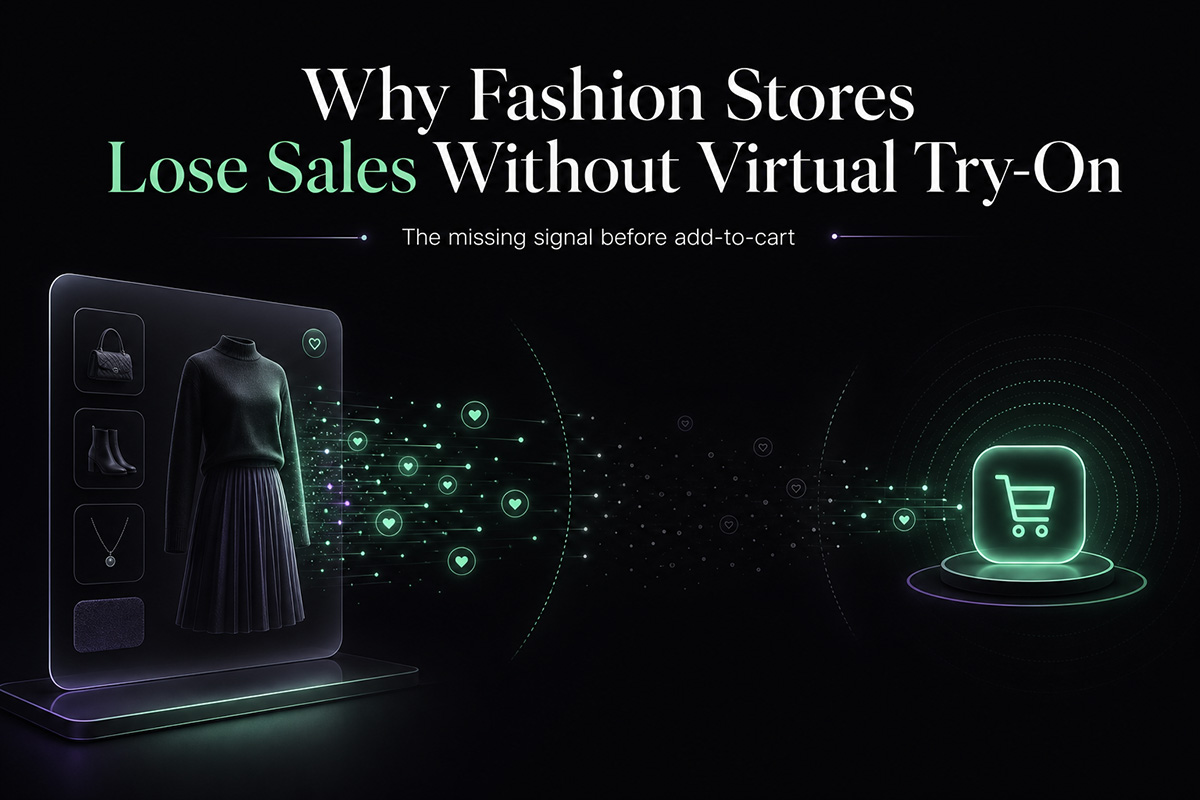
For fashion ecommerce, AI virtual try-on should not be treated as a visual trick. The real value is whether it can help shoppers move from product interest to add-to-cart.
That is where ETRYON is different from a basic try-on widget.
ETRYON is designed to bring the missing conversion moments of an offline clothing store into Shopify and WooCommerce product pages.
The offline store still has a stronger middle step
A physical clothing store does not sell only through product photos.
The shopper walks in. She touches the fabric. She tries the item on. A staff member gives a short suggestion. If she is close to buying, there may be a timely offer or a final nudge.
That middle step matters.
Most online fashion stores compress the entire journey into:
Product image → Size selector → Add to cart
That is efficient, but thin.
There is no fitting room. No quick styling read. No one saying, "This color works better for evening wear." No well-timed offer after the shopper has shown real intent.
ETRYON does not try to copy a physical store completely. That would be unrealistic.
Instead, it rebuilds the useful parts inside the product page.
1. Product-page virtual try-on: the online fitting room
Many AI try-on tools feel like a separate demo.
The shopper opens a widget, generates an image, closes it, and then has to return to the product page to keep shopping.
That breaks the buying flow.
ETRYON puts AI virtual try-on where the purchase decision already happens: the product page.
For Shopify stores, ETRYON works through a product-page app block. For WooCommerce stores, it works through the WordPress plugin and product-page modal.
The point is simple: shoppers should not leave the product context to try something on.
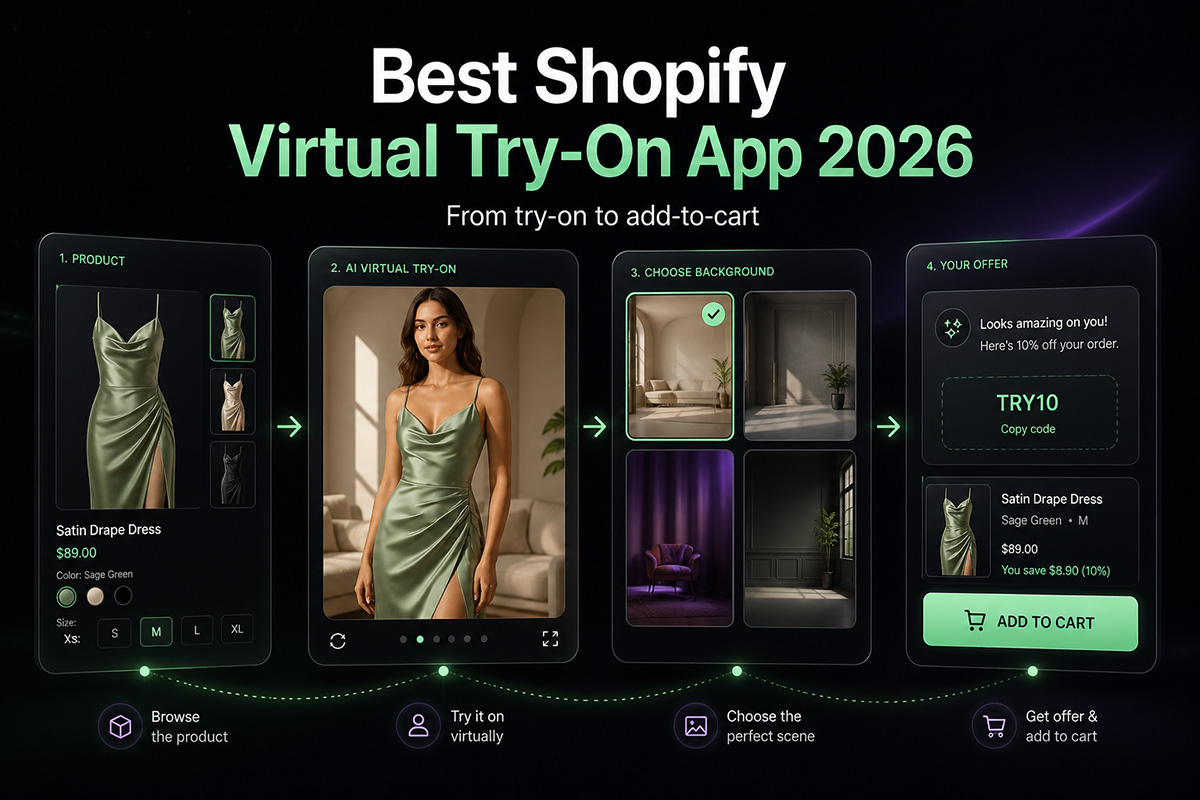
They should be able to view the product, try it, review the result, and continue toward add-to-cart in one flow.
That is the ecommerce version of a fitting room.
2. AI Shopping Guide: the missing sales associate
A fitting room alone is not always enough.
In a physical store, a good sales associate does not talk for five minutes. Usually, one useful sentence is enough.
"This shape works well for a dinner look."
"Try it with a cropped jacket."
"The darker shade is easier to style across seasons."
Online product pages rarely have that layer.
ETRYON adds it after a successful try-on.
The AI Shopping Guide can show a short product-specific verdict, occasion cues, and one practical styling tip. It is not written as generic AI copy. It is designed to help the shopper understand what the try-on result means.
This matters because a generated image can show the outfit, but it does not automatically explain the product.
ETRYON helps the product page continue the conversation after the try-on result appears.
3. Post-try-on offers: the online version of timely negotiation
Offline stores often have a flexible closing moment.
A salesperson might mention a member discount, a limited store offer, or a small incentive when the shopper is already interested.
Online stores usually get the timing wrong.
They show a discount popup as soon as someone lands on the site, before the shopper has looked at the product, selected a variant, or shown any intent.
ETRYON supports post-try-on offers.
That means the offer can appear after a shopper has completed the try-on and viewed the result. The timing is more relevant because the shopper has already interacted with the product.
This is not about pushing discounts everywhere.
It is about placing the offer closer to the buying moment.
4. Variant-aware add-to-cart flow: no dead end after the result
A basic try-on tool often stops after image generation.
For clothing stores, that is not enough.
Fashion products depend on variants: color, size, style, pattern, length, and sometimes material. A shopper who tries a green dress should not be forced to restart the buying path just to confirm the correct option.
ETRYON connects the try-on result back to product options and add-to-cart actions.
Depending on the store setup, the result flow can stay close to:
- Selected product context
- Variant options
- Product information
- Add-to-cart action
- Cart continuation
That connection is important.
The try-on result should not be a visual island. It should be part of the sales path.
5. Try-on analytics: see what happens after interest
Offline stores can observe behavior.
A shopper enters the fitting room. She asks for another size. She checks the mirror twice. She leaves with the item or puts it back.
Online stores need their own version of that signal.
ETRYON tracks key storefront events around the try-on flow, including button impressions, clicks, modal opens, uploads, generation starts, generation success, failures, post-try-on add-to-cart actions, offer interactions, and shopping guide events.
That gives merchants a better question to ask.
Not just: "How many images were generated?"
But:
- Which products get try-on clicks?
- Which products lead to successful try-ons?
- Which results lead to add-to-cart?
- Which offers get clicked or ignored?
- Which collections deserve more try-on coverage?
That is how virtual try-on becomes a merchandising tool, not just an AI feature.
ETRYON is not just "try before you buy"
The phrase "try before you buy" is useful, but incomplete.
For fashion stores, the better goal is:
Try it.
Understand it.
Get a relevant next step.
Add it to cart.
That is the difference between a try-on widget and a conversion-oriented product-page system.
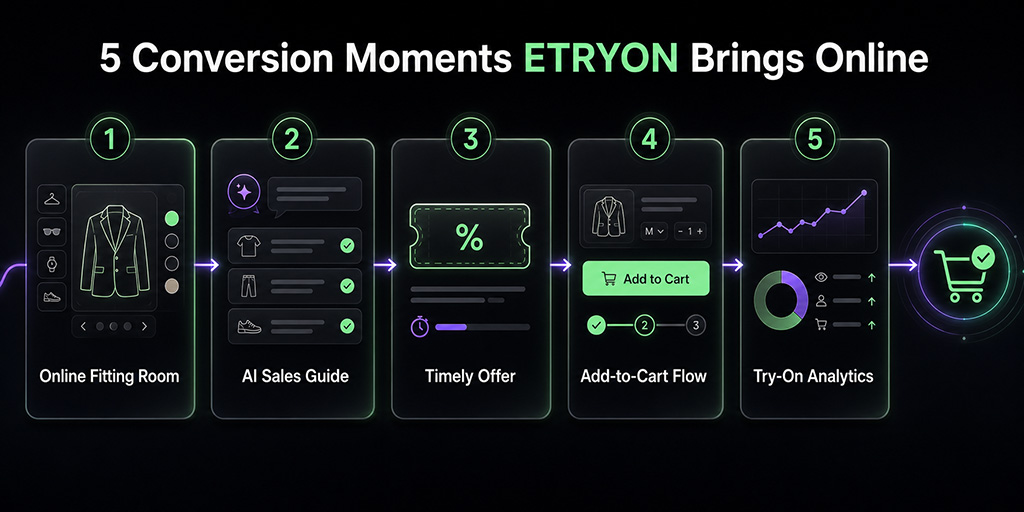
ETRYON brings together the parts that online fashion stores usually miss:
- The fitting room: AI virtual try-on
- The sales associate: AI Shopping Guide
- The timely incentive: post-try-on offer
- The checkout path: add-to-cart flow
- The store manager's view: try-on analytics
Each part has value on its own. Together, they create a stronger path from browsing to buying.
Final takeaway
Physical fashion stores still convert well because they have a middle layer between seeing a product and paying for it.
Online fashion stores need that layer too.
ETRYON helps Shopify and WooCommerce fashion stores add it directly to the product page: shoppers can try on products, receive useful guidance, see a relevant offer when configured, and continue toward add-to-cart without leaving the flow.
Explore the ETRYON Apps page or try the live demo.
Related reading
- Why Choose ETRYON for AI Virtual Try-On
- How ETRYON Virtual Try-On Helps Increase Add-to-Cart Rates for Fashion Stores
- How Post-Try-On Offers Help Turn Fashion Browsers Into Buyers


.avif)

